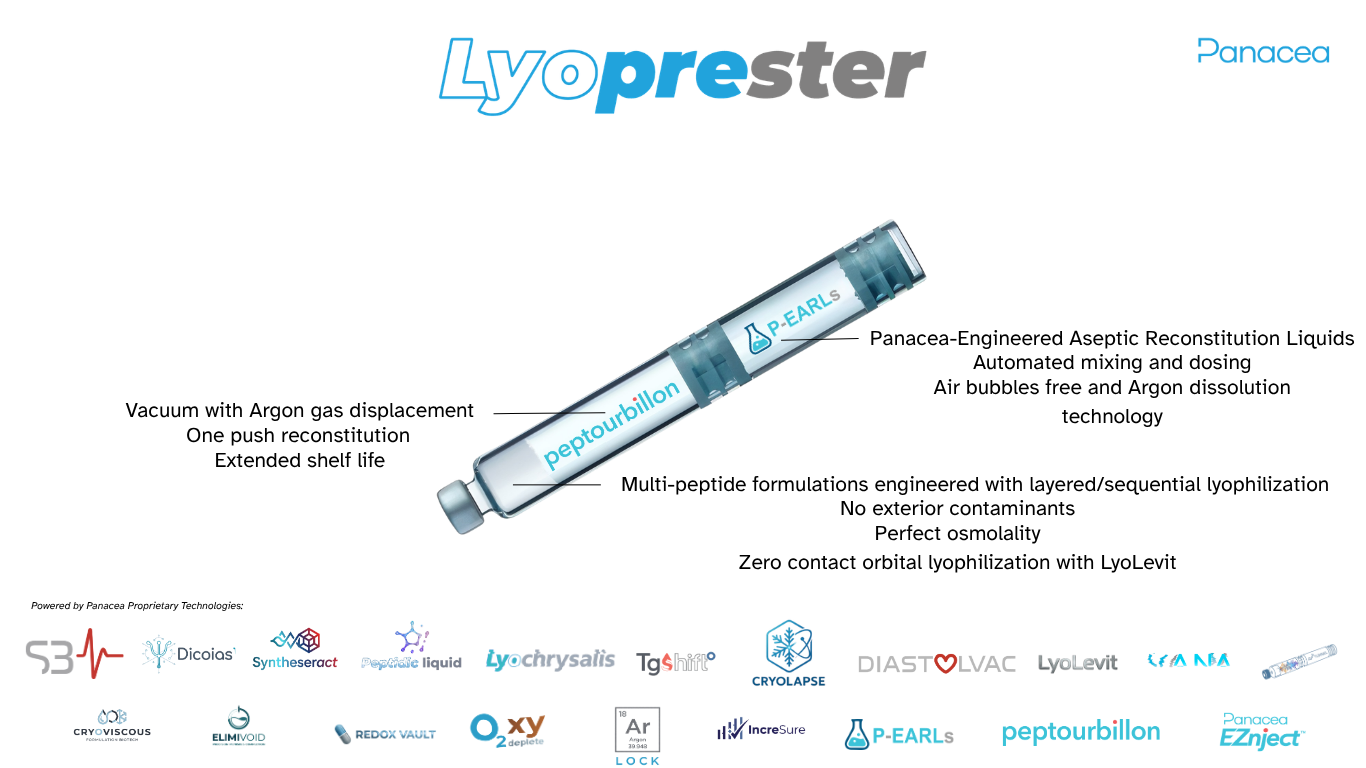
RF Tunnel: complete, rapid reconstitution of lyophilized peptide cakes
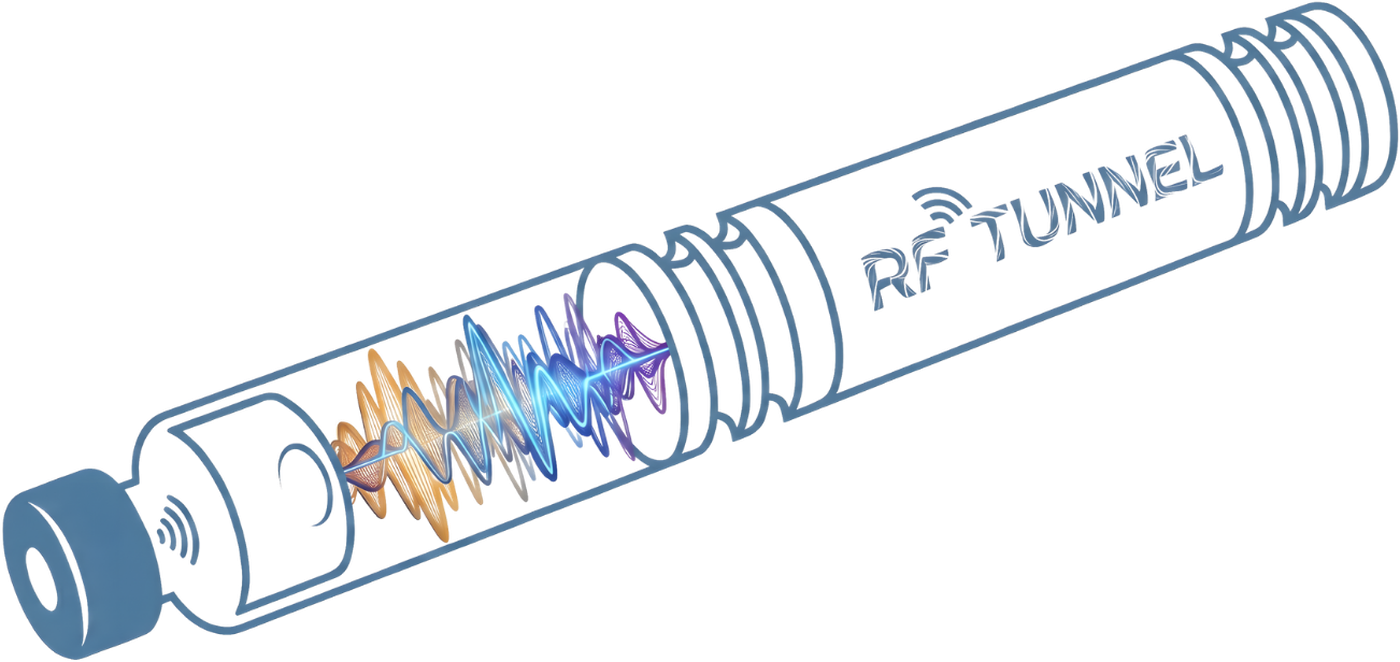
RF Tunnel™ is a reconstitution technology that prepares a lyophilized peptide cake to redissolve from the inside as well as the outside. During finishing, radio-frequency energy is directed at the centre of the cake to open a slender central channel — a tunnel — through the dried mass. When solvent is later introduced, liquid enters from that channel and from the outer surface at the same time, so the whole cake wets together instead of a dense core dissolving last. In Panacea's system it is orchestrated inside the Lyochrysalis™ dryer under the S3Pulse™ control algorithm and delivered in the Lyoprester® dual-chamber cartridge, where a single tap reconstitutes the dose.
1. The goal: complete reconstitution
Reconstitution1 is the step that turns a shelf-stable freeze-dried cake back into a solution ready to use. A good reconstitution is fast and complete: every milligram of the lyophilized2 cake goes back into solution, at full strength, with nothing left behind. That is the whole point of drying a peptide for storage — to deliver it, intact, on demand.
A dense cake, though, can wet unevenly. Liquid meets the outer surface first, and the wetted outer layer can slow the passage of solvent inward — a dissolution3 front that has to travel from the skin to the centre. For small cakes this is quick; for larger fills the interior can be the last to dissolve. The opportunity is clear: give the liquid a second way in.
2. Principle: a channel to the core
What "RF Tunnel" means
RF Tunnel adds that second route. Rather than leaving the cake as a solid block that can only be wetted from its skin inward, RF Tunnel forms a central channel running through the cake. Reconstitution then happens on two fronts at once — inward from the surface, and outward from the channel at the core — so the dry centre meets solvent early instead of last.
One cake, two wetting fronts: the surface and the core dissolve together, so nothing is left waiting in the middle.
3. Mechanism
- The peptide is frozen and dried into a stable cake inside the Lyoprester® cartridge.
- During finishing, radio-frequency4 energy is directed at the cake's centre, shaping a slender central channel through the dried mass.
- The finished cake carries that channel — a built-in path from the core to the surface.
- On reconstitution, solvent wets the outer surface and travels down the central channel together, so the cake dissolves from the middle and the edge at the same time.
4. What it changes
| Dimension | Surface-only wetting | RF Tunnel |
|---|---|---|
| Wetting fronts | One — outer surface inward | Two — surface and core |
| Dry-core risk on larger fills | Interior dissolves last | Core wets early |
| Reconstitution completeness | Can leave undissolved centre | Whole cake wets together |
| Operator steps | Swirl / wait / inspect | Single-tap in the cartridge |
| Excipients added for wetting | Sometimes surfactants | None on this account |
Because the channel is a geometry built into the cake rather than a chemical wetting aid, RF Tunnel improves reconstitution without adding surfactants to the formulation — keeping the delivered solution as close to pure peptide and its intended excipients as possible.
5. The hard cases: heavy loads, fatty peptides, stubborn APIs
Not every cake dissolves the same. Surface-only wetting is adequate for small, light, hydrophilic cakes — and it fails exactly where the stakes are highest: the dense, heavy-loaded, hydrophobic and high-potency cakes that carry the most valuable dose. These are the cases RF Tunnel is built for.
- Heavy-loaded, high-solids cakes. A high peptide-plus-excipient mass dries into a dense, low-porosity cake with a thick geometry. The dissolution front has farther to travel and a tighter, more tortuous pore network to travel through, while the wetted outer layer can gel and seal into a low-permeability skin before solvent ever reaches the interior — trapping a dry or gelled core, slowing dissolution and losing dose.
- Fatty, lipidated and hydrophobic peptides. Acylated, palmitoylated and lipid-conjugated peptides (the incretin/GLP-class and beyond) present a hydrophobic surface: water beads and de-wets instead of penetrating, so the cake floats, foams and redissolves slowly — the worst possible case for wetting from the outside in.
- High-potency, poorly-soluble API. Concentrated, near-saturation cakes throw a viscous gel layer at the wetting front (local supersaturation) that further blocks liquid ingress — the classic gel-block that leaves an undissolved centre.
In all three the failure mode is identical: liquid can only enter from the outside, and the outside seals before the inside dissolves. RF Tunnel removes that single point of failure by changing the cake's geometry — a central channel gives solvent a second, interior entry route, so capillary flow carries liquid down the channel into the dense or hydrophobic core at the same moment the surface wets. The heavier and more stubborn the cake, the more that interior route decides the outcome. For these cakes RF Tunnel is not a convenience — it is what makes complete, accurate, single-tap reconstitution possible without surfactants, warming, vigorous shaking, or long waits that stress a fragile peptide.
6. System integration
RF Tunnel lives inside Panacea's drying and delivery stack. The cake is dried in the Lyochrysalis™ lyophilizer under the S3Pulse™ control algorithm →, then delivered in the Lyoprester® dual-chamber cartridge — cake in one chamber, the P-EARL™ reconstitution liquid in the other. A single tap draws the liquid into the cake; the central channel is what lets that draw reach the core immediately. RF Tunnel engages for the larger-volume fills where a dry centre would otherwise matter most, and is applied as its own drying mode.
The energy settings, timing and channel geometry that make RF Tunnel repeatable within a defined process tolerance remain proprietary to Panacea Bio Chem — the outline is here; the recipe stays behind the door.
7. Where it helps most
- Heavy-loaded, high-solids cakes — dense, low-porosity, thick geometry
- Fatty / lipidated / hydrophobic peptides that resist surface wetting
- High-potency or poorly-soluble APIs prone to a gel-block at the wetting front
- Larger-volume peptide cakes, where the interior would otherwise dissolve last
- Dual-chamber cartridges built for single-tap, in-place reconstitution — e.g. Lyoprester®
- Formulations that aim to minimise wetting-aid excipients
- Point-of-use redissolution where a quick, whole-cake dissolve matters
Frequently asked
What is RF Tunnel?
RF Tunnel is Panacea Bio Chem's reconstitution
technology: during drying it shapes a central channel through the lyophilized
peptide cake, so that when solvent is added the cake dissolves from its core and its
surface at the same time — fast, complete reconstitution with no trapped dry centre.
Why do freeze-dried cakes sometimes reconstitute incompletely?
A dense
cake can wet at its outer surface first, and that wetted layer can slow liquid from
reaching the interior — leaving a slow-dissolving core, especially on larger fills. RF
Tunnel gives the liquid a second entry route through a pre-formed central channel.
Who developed RF Tunnel?
RF Tunnel was developed by Bogdan Dicoias
and is the intellectual property of Panacea Bio Chem Ltd — alongside the
Lyoprester® cartridge, Cryolapse™, DiastolVAC™ and the S3Pulse™ control algorithm.
Trending in the field
Recent developments in the field — refreshed 2026-10-18 by Panacea Bio Chem.
- Arginine regulates intermolecular interactions to stabilize lyophilized high-concentration omalizumab: dry-state characterizations and molecular dynamics insights into reconstitution and viscosity — PubMed, 2026 Oct 16
- Composition-dependent amorphous matrix formation controls vitamin C stability in reconstituted freeze-dried lactose-whey protein isolate systems — PubMed, 2026 Oct 1
- Lyophilized rumen fluid from goats fed different roughage-based diets: fermentation characteristics, microbial communities, and post-reconstitution in vitro fermentation performance — PubMed, 2026
- Development of chondroitin sulfate‑stabilized PLGA microspheres of exenatide via polarity gradient extraction — PubMed, 2026 Sep 18
References & further reading
- Reconstitution of a lyophilized product. Wikipedia — Freeze drying.
- Freeze drying (lyophilization). Wikipedia.
- Dissolution and wetting of solids. Wikipedia.
- Radio frequency and dielectric heating. Wikipedia.
- Reconstitution of lyophilized peptides — literature. PubMed.